
NDIS Practice Standards Reform 2026: Document Review

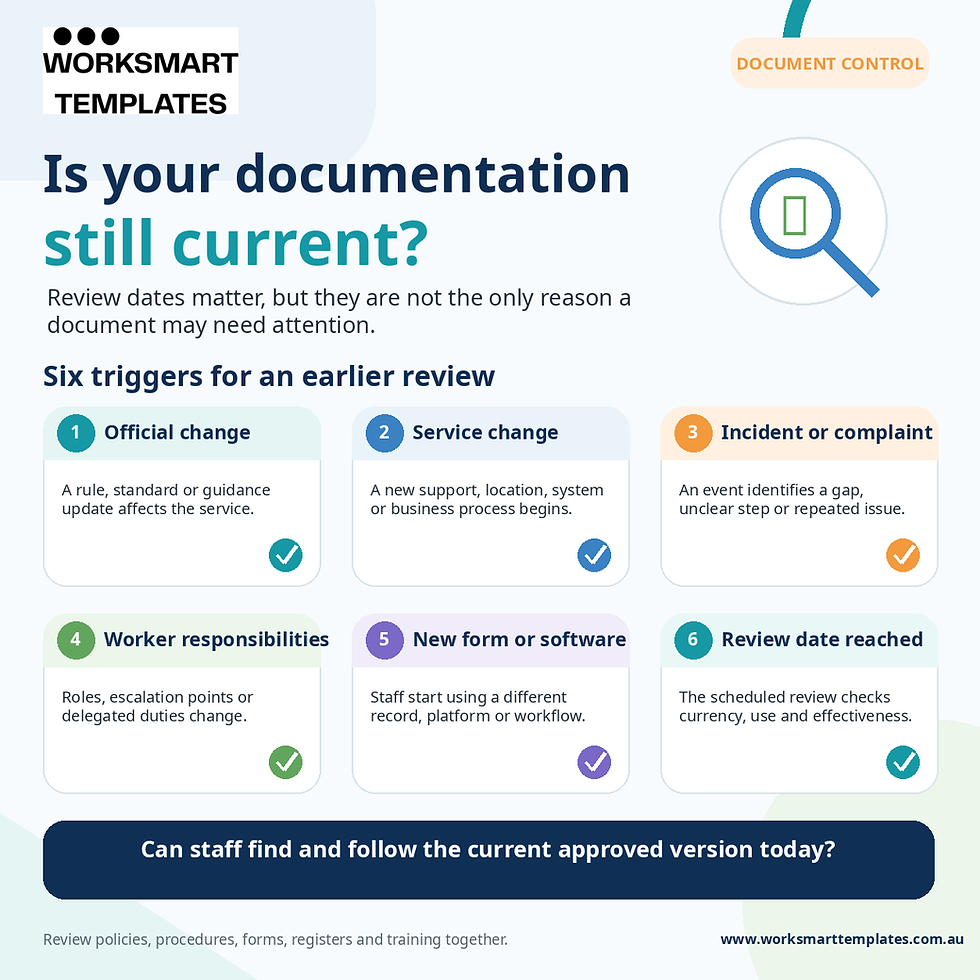
Updated: Jul 8
Information current as at 7 July 2026
The NDIS Practice Standards reform makes it important for providers to have a clear process for reviewing affected policies, procedures, forms, registers and staff instructions.
A policy can be professionally written, approved and stored in the correct folder—and still be out of date.
Documents often become outdated gradually. A procedure changes, a new form is introduced, responsibilities shift or staff begin following an informal process that is no longer consistent with the written policy.
This risk is particularly relevant in 2026. The NDIS Quality and Safeguards Commission is continuing its regulatory reform program and reviewing the NDIS Practice Standards. New Supported Independent Living Practice Standards also apply to relevant SIL providers from 1 July 2026.
Providers do not necessarily need to rewrite every document at once. They do, however, need a reliable process for identifying changes, reviewing affected documents and making sure written procedures continue to match everyday practice.
This guide explains how providers can approach that process without creating unnecessary paperwork.
What Does the NDIS Practice Standards Reform Mean for Providers?
The NDIS Practice Standards describe the quality standards registered NDIS providers must meet when delivering supports and services.
The Standards are divided into different modules, including:
A core module for registered providers delivering higher-risk supports
Supplementary modules for particular types of supports
A verification module for registered providers delivering lower-risk or lower-complexity supports
Each module contains participant-focused outcomes and quality indicators that auditors use when assessing provider compliance.
The Practice Standards should not be viewed as a list of policy titles alone. They affect how providers:
Design their systems
Deliver supports
Train and supervise workers
Protect participant rights
Manage risk
Respond to incidents and complaints
Record evidence of everyday practice
A policy may explain what should happen, but related forms, registers, staff instructions and completed records help demonstrate how that process operates in practice.

What Is Changing in 2026?
The NDIS Commission is currently reviewing the broader NDIS Practice Standards as part of its regulatory reform program. Providers should monitor official updates rather than treating proposed amendments or consultation material as final requirements. The Commission has specifically advised providers to refer to the final rules once they are made when determining whether proposed notification and ownership requirements apply.
A major confirmed change is the introduction of new Practice Standards for Supported Independent Living.
Relevant SIL providers must be registered from 1 July 2026 and comply with the new SIL Practice Standards.
These standards address areas including:
Supported decision-making
Safeguarding
Practice governance
Agreements concerning tenancy, housing and support arrangements
Consistent service delivery
Participant safety
Provider accountability
Providers delivering SIL should therefore review more than a single policy. The changes may affect participant agreements, worker instructions, risk processes, governance systems, training materials, support-planning records and evidence of participant involvement.
The NDIS Code of Conduct Still Matters to Every Provider
The NDIS Code of Conduct applies to registered and unregistered NDIS providers, their key personnel and workers.
It requires people delivering NDIS supports to:
Respect individual rights, self-determination and decision-making
Respect participant privacy
Deliver supports safely and competently
Act with integrity, honesty and transparency
Respond promptly to concerns affecting support quality and safety
Take reasonable steps to prevent and respond to violence, exploitation, neglect, abuse and sexual misconduct
Avoid unjustified higher prices for NDIS participants
This means document review is relevant even for providers who are not currently registered.
A provider may not be undergoing a registration audit, but its policies, agreements, records and staff practices should still reflect the expectations of the NDIS Code of Conduct.
A Practical Documentation Review Process
1. Start With an Official Change
Avoid updating policies solely because of a social media post, informal checklist or second-hand summary.
Start by confirming:
What has changed
Whether the change is final
The commencement date
Which providers or supports are affected
Whether transitional arrangements apply
Which official rules, standards or guidance explain the change
Save a copy or record the official source used during the review.
This creates a clearer basis for any amendments and helps explain why a document was changed.
2. Identify Every Document the Change Could Affect
A regulatory change rarely affects only one policy.
For example, a change to incident-management expectations might affect:
Incident Management Policy
Incident Reporting Procedure
Internal Incident Report Form
Incident Register
Escalation flowchart
Worker induction material
Manager responsibilities
Participant information
Training records
Internal audit checklists
Review the whole documentation pathway rather than editing one isolated file.
A useful question is:
What documents do workers use before, during and after this process?
3. Compare the Written Process With Actual Practice
Ask workers and managers what currently happens.
You may discover that:
Staff use a different form from the approved version
Responsibilities have changed
A step is no longer practical
A new software system has replaced the original process
Workers are unsure who should receive a notification
Completed records are stored in several locations
The policy contains wording that staff do not understand
Updating documentation without checking actual practice may preserve a process that is already ineffective.
The review should consider both directions:
Does practice need to change to match the approved policy?
Does the policy need to change because the approved process has legitimately changed?
4. Review Policies, Procedures, Forms and Registers Together
These documents have different functions.
Policy
Explains the organisation’s position, commitments and broad responsibilities.
Procedure
Explains the steps staff should follow.
Form
Prompts the person completing a task to record required information.
Register
Tracks events, actions, reviews, trends or outstanding responsibilities over time.
Checklist
Helps confirm that required steps or evidence have been considered.
A strong documentation system connects these documents clearly.
For example, a complaints policy may state that complaints are reviewed for improvement opportunities. The complaint form should capture relevant information, while the complaint register should allow trends and outstanding actions to be monitored.
5. Use Clear Version Control
Every controlled document should make it possible to identify:
Document title
Document owner
Version number
Approval date
Effective date
Next review date
Person or role approving the document
Summary of changes
Superseded version
When a document is replaced, remove or archive outdated versions so workers do not continue using them.
File names such as Final Policy, Final Policy New, and Final Policy Updated 2 make it difficult to know which document is current.
A clearer file name might be:
Incident Management Policy – Version 3.0 – Effective 1 July 2026
6. Communicate the Change to Workers
Uploading an updated policy does not mean staff have read or understood it.
Depending on the significance of the change, communication may involve:
A written summary
Team discussion
Formal training
Updated induction material
Scenario-based practice
Acknowledgement that the document was read
Competency assessment
Supervision follow-up
The NDIS Commission provides workforce resources that translate the Code of Conduct and Practice Standards into observable worker behaviours. It also identifies the Worker Orientation Module as mandatory for staff of registered NDIS providers.
Training should explain what workers need to do differently—not simply announce that a policy has been updated.
7. Keep Evidence That the Change Was Implemented
Evidence may include:
Approved policies and procedures
Staff training attendance
Worker acknowledgements
Completed forms
Updated registers
Meeting minutes
Supervision discussions
Internal audits
Corrective-action records
Participant communications
Updated agreements
Review outcomes
The most useful evidence is created through normal service delivery.
Providers should avoid generating unnecessary paperwork purely for an audit. Instead, the aim should be to create records that support safe practice, continuity, accountability and participant rights.
Documentation Areas Worth Reviewing in 2026
Participant Choice and Support Planning
Check whether your documents clearly address:
Participant involvement
Supported decision-making
Communication preferences
Goals and outcomes
Consent
Review triggers
Changes in needs or circumstances
How disagreements are handled
The NDIS Person-Centred Support Planning Policy Template provides an editable starting point for documenting planning, participant choice, staff responsibilities, reviews and service adjustments. It should be reviewed and customised to suit the provider’s actual services and current requirements.
Workforce and Recruitment Records
Review whether recruitment and workforce documents cover:
Position responsibilities
Screening and checks
Qualifications
Induction
Mandatory training
Ongoing professional development
Supervision
Performance concerns
Worker records
Exit processes
The NDIS Human Resources and Recruitment Policy Template may assist providers to structure their recruitment, onboarding, training, supervision and workforce record-keeping processes.
Incident and Risk Documentation
Check whether workers understand:
What constitutes an incident
How to respond immediately
Who must be notified internally
When escalation is required
How follow-up is assigned
How corrective actions are monitored
How incident information is reviewed for patterns
The NDIS Internal Incident Report Form Template provides fields for documenting incidents, near misses, hazards, injuries and follow-up actions. It does not replace the provider’s incident-management system or external notification obligations.
Daily Service Records
Everyday records should reflect what was actually delivered.
Review whether notes capture:
Type and duration of support
Participant choices and involvement
Relevant observations
Progress or outcomes
Risks or changes
Actions taken
Follow-up requirements
Links to separate incident processes where relevant
The NDIS Daily Support Log Template is designed to help teams record daily activities, supports, observations, risks, incidents and important updates in a consistent format.
Financial Governance and Pricing
Review documents covering:
Agreed prices
Invoicing
Payment processes
Participant communication
Financial records
Refunds and corrections
Delegated authority
Financial risk
Transparency
Changes to service agreements
The NDIS Financial Management Policy Template provides an editable framework covering invoicing, pricing, payment processes, financial controls and accountability. It should be adapted to the organisation’s actual systems and professional requirements.
Use a Master Document List
One of the most practical ways to manage change is to maintain a central document list.
A useful document register may record:
Field | Purpose |
Document title | Identifies the controlled document |
Document owner | Assigns responsibility |
Current version | Prevents use of superseded files |
Approval date | Shows when it was authorised |
Effective date | Shows when the change began |
Review date | Prompts scheduled review |
Change trigger | Records why it was updated |
Related documents | Connects policies, forms and registers |
Training required | Identifies worker communication needs |
Status | Shows whether review is complete |
The Master NDIS Policy Index & Document List may provide a practical starting point for organising policies and tracking documentation. Providers should still determine which documents apply to their registration groups, service model and circumstances.
A Simple 30-Day Review Plan
Week 1: Identify
Check current official NDIS Commission updates
Identify which changes apply to your service
List affected policies, procedures, forms and registers
Assign a responsible person
Week 2: Compare
Compare current documents with the official requirements
Speak with workers about actual practice
Record gaps, inconsistencies and outdated instructions
Prioritise higher-risk areas
Week 3: Update
Amend the affected documents
Apply version control
Update related forms and staff instructions
Obtain appropriate approval
Week 4: Implement
Communicate changes
Train relevant workers
Remove superseded documents
Begin using the updated forms
Schedule a follow-up review
This approach allows providers to work through changes methodically rather than attempting to rewrite the entire documentation system at once.
Final Thoughts
Regulatory reform does not mean providers should immediately replace every policy.
The more reliable approach is to:
Confirm what has changed
Identify who is affected
Review connected documents
Compare written processes with actual practice
Update forms and worker instructions
Communicate and implement the change
Keep evidence that the process is working
Documentation should remain a living part of service delivery—not a folder opened only before an audit.
A strong system helps workers know what to do, supports consistent decision-making and provides clearer evidence of how participant rights, safety and service quality are being supported.
Disclaimer
This article provides general administrative and operational information only. It does not constitute legal, regulatory, financial, audit or professional advice. NDIS requirements and reform arrangements may change. Providers should review current official NDIS Commission information, their registration conditions, applicable Practice Standards and professional advice before changing their policies or procedures.

